Google Ads Conversion Lift: Is Your ROAS Actually Incremental?
Google Ads is making Conversion Lift more accessible for Search and Performance Max campaigns. But a lift study is only useful if it changes how you allocate budget. Here is how to interpret the results, understand their limitations and connect incremental revenue to actual profitability.

Google Ads Conversion Lift: How to Know Whether Your ROAS Is Actually Incremental
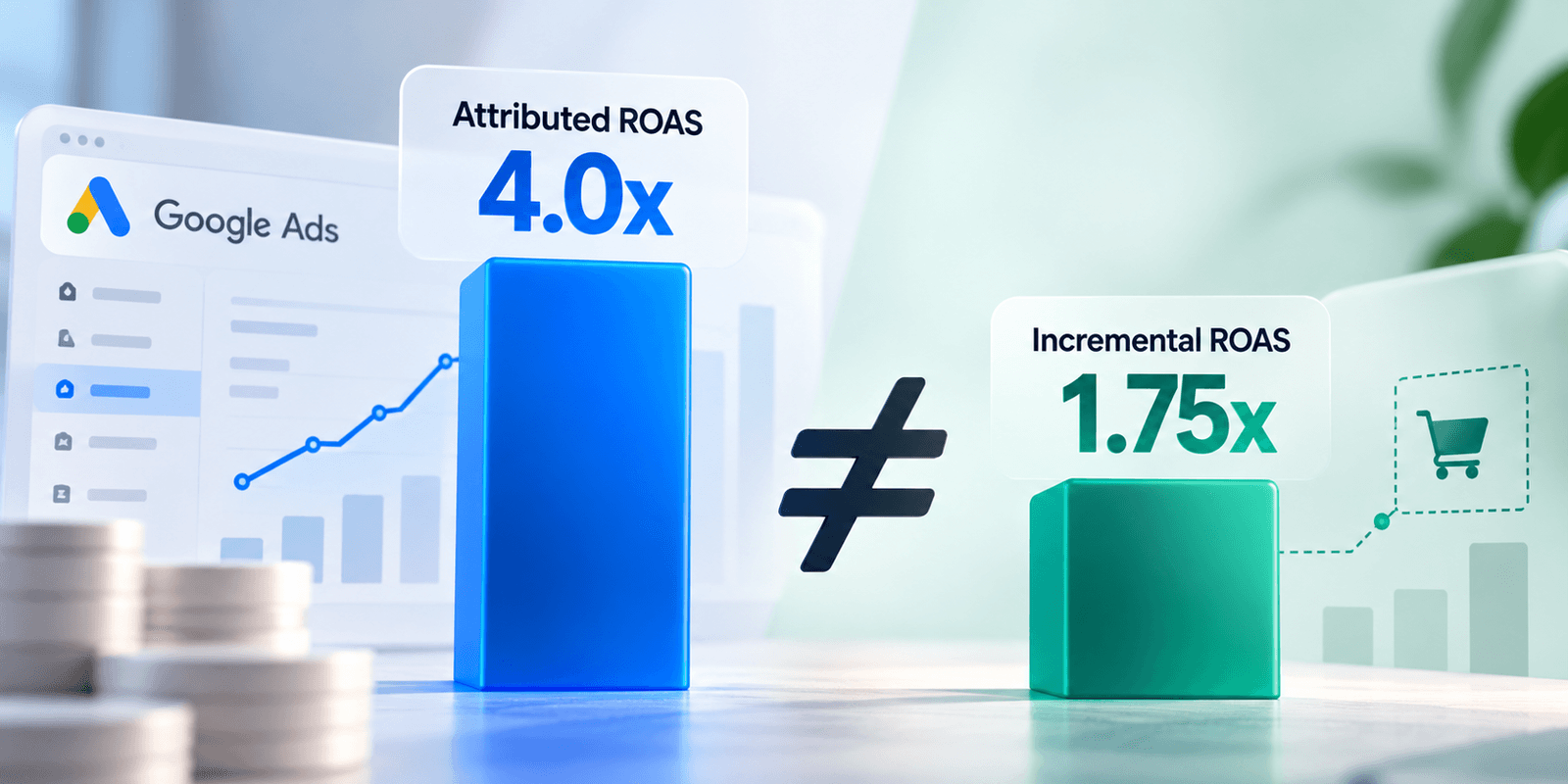
A Google Ads campaign can report a 400% return on ad spend and still be a poor investment.
The reason is straightforward: attributed conversions are not necessarily incremental conversions. Some customers would have purchased without seeing the ad. Others might have arrived through organic search, direct traffic or another marketing channel.
That distinction becomes particularly important when evaluating automated campaigns such as Performance Max, where reported conversions can reflect different stages of existing and newly generated demand.
Google Ads now documents user-based Conversion Lift support for Search and Performance Max campaigns, with an expanded self-service setup workflow for eligible accounts. However, Google explicitly states that Conversion Lift is not available to every advertiser and that some accounts require assistance from a Google representative.
For growth leaders, the important opportunity is not simply easier experimentation.
It is the ability to ask a more commercially meaningful question:
How much additional business does our advertising actually create?
What changed with Google Ads Conversion Lift?
Google Ads Conversion Lift uses controlled experiments to estimate the additional conversions generated by advertising.
Google's current documentation lists Search and Performance Max among the campaign types supported by user-based Conversion Lift, alongside Display, Video, Demand Gen and eligible App campaigns.
The published minimum requirements include:
- At least 1,000 observed conversions.
- A participating campaign budget of at least $5,000 USD.
- At least one compatible conversion action.
- An eligible Google Ads account and campaign configuration.
Conversions using supplementary data do not count towards the minimum observed-conversion threshold.
Meeting these requirements does not guarantee access or a conclusive experiment. Google continues to state that account eligibility varies.
The current setup workflow is documented under Campaigns → Experiments → Lift studies, although advertisers should confirm the available interface in their own accounts.
For details, see Google's official user-based Conversion Lift setup guide.
Why this matters for Search and Performance Max
Search and Performance Max can capture demand that already exists.
A user searching for a specific brand may have strong purchase intent before encountering an advertisement. A Performance Max campaign can also reach customers across multiple Google advertising surfaces and stages of the buying journey.
Standard conversion attribution assigns credit according to configured attribution rules.
It does not establish what would have happened without the advertising.
Conversion Lift attempts to answer that counterfactual question.
For mature accounts with substantial spending, the difference can materially change budget allocation.
What is the difference between ROAS and incremental ROAS?
ROAS measures attributed conversion value divided by advertising spend. Incremental ROAS measures the additional conversion value caused by advertising, divided by advertising spend.
These are not interchangeable.
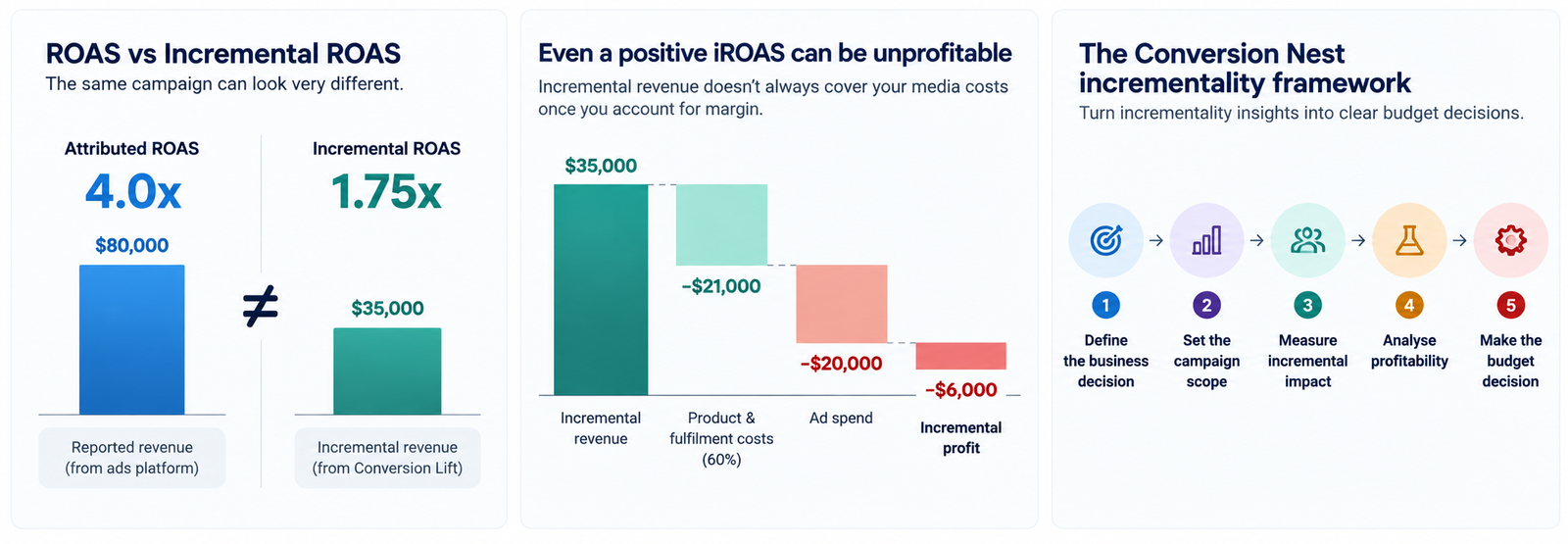
Consider a hypothetical campaign that spends $20,000 and reports $80,000 in attributed revenue.
Its reported ROAS is:
$80,000 ÷ $20,000 = 4.0x
That looks attractive.
Now imagine a properly designed Conversion Lift study estimates that the campaign generated only $35,000 in additional revenue beyond what would have happened without the measured advertising.
Its incremental ROAS becomes:
$35,000 ÷ $20,000 = 1.75x
The campaign still generated additional revenue. But its economic value is substantially different from what standard attribution suggested.
This is an illustrative example, not a client result.
Google defines incremental ROAS using incremental conversion value divided by advertising spend. Its documentation also distinguishes incremental conversions from conversions recorded under standard attribution settings.
See Google's Conversion Lift measurement definitions.
Why even incremental ROAS can be misleading
Incremental ROAS is closer to the commercial question than attributed ROAS.
But revenue is not profit.
A retailer with a 70% contribution margin can afford a different acquisition cost from a retailer operating at a 25% margin.
The same applies to subscription businesses, marketplaces and travel companies, where fulfilment costs, commissions, payment fees, refunds and retention economics vary.
Return to the hypothetical campaign:
MetricResult
Advertising spend
$20,000
Attributed revenue
$80,000
Reported ROAS
4.0x
Estimated incremental revenue
$35,000
Incremental ROAS
1.75x
Assumed contribution margin before advertising
40%
Incremental contribution before advertising
$14,000
Incremental contribution after advertising
-$6,000
The campaign appears highly successful when evaluated using attributed ROAS.
Under the stated assumptions, however, the estimated incremental revenue generates only $14,000 in contribution before advertising against $20,000 in media costs.
That produces negative incremental contribution after advertising.
The campaign may still have strategic value through customer retention, repeat purchases or longer-term effects. Those benefits would need to be estimated separately.
But the short-term economics do not support an automatic budget increase.
Calculate the break-even incremental ROAS
For a business using revenue-based conversion values, a simplified break-even formula is:
Break-even iROAS = 1 ÷ contribution margin
At a 40% contribution margin:
1 ÷ 0.40 = 2.5x
In this simplified model, the campaign needs an incremental ROAS of at least 2.5x to cover its media costs.
The calculation assumes contribution margin is measured before advertising and excludes additional acquisition costs, fixed overhead and longer-term customer value.
Conversion Nest's recommendation is to evaluate incremental ROAS against contribution economics, not against an arbitrary platform benchmark.
A 2.0x incremental ROAS could be excellent for one business and economically unsustainable for another.
How does a Google Ads Conversion Lift study work?
Google's user-based Conversion Lift methodology compares outcomes between two groups.
The treatment group is eligible to see the advertising being measured.
The control group is held back from those ads.
By comparing conversion outcomes between the groups, the experiment estimates the additional conversions attributable to the measured campaigns.
The resulting metrics can include incremental conversions, relative lift, incremental conversion value, incremental CPA and incremental ROAS.
The principle is simple. The execution requires care.
A valid comparison must account for differences in group sizes and the experiment's statistical design. Advertisers should use the platform's lift estimates and uncertainty information rather than subtracting unadjusted conversion totals from groups of unequal size.
A lift study also measures the contribution of the campaigns included in the experiment—not necessarily the incremental value of the entire Google Ads account.
Other advertising may continue to reach users in both groups.
That distinction matters when interpreting the result.
Google explains the methodology in its Conversion Lift documentation.
The Conversion Nest framework: Design the decision before the experiment
The most common strategic mistake is treating incrementality testing as another reporting exercise.
A growth team launches a study, receives a lift percentage and adds it to an executive dashboard.
Nothing changes.
A better approach starts by identifying the decision the experiment needs to support.
Conversion Nest recommends a five-part framework.
1. Define the commercial decision
Do not begin with the question, "What is our incremental ROAS?"
Begin with:
What decision will change depending on the result?
For example:
- Should we increase Performance Max spending by 20%?
- Should branded Search retain its current budget?
- Should we move investment from retargeting into prospecting?
- Should we restructure campaigns that appear to capture existing demand?
Each question requires a different experiment design.
If the result cannot influence a meaningful decision, the study may not justify its cost.
2. Choose the correct campaign scope
Google recommends selecting campaigns based on the question being investigated.
Measuring one Performance Max campaign estimates its additional contribution while other marketing activity continues.
Measuring a broader collection of campaigns may provide a more useful estimate of the combined contribution of that activity.
These are different causal questions.
For example, measuring only one branded Search campaign while several other brand-focused campaigns remain active will not reveal the incremental impact of all brand advertising.
The control group may still encounter other campaigns.
The experiment should therefore reflect the budget decision being considered.
3. Select a commercially meaningful conversion
Conversion volume matters because more frequent outcomes can make lift easier to detect.
But choosing a high-volume event purely to improve statistical power creates another problem.
A landing-page visit is not a qualified lead.
A lead is not necessarily a customer.
A purchase is not necessarily profitable.
For ecommerce businesses, purchase value may be a useful primary outcome.
For B2B businesses, qualified leads or downstream CRM outcomes may be more commercially relevant, provided the measurement setup supports them.
Google recommends considering both lower-funnel and more frequent upper- or mid-funnel conversion actions.
The correct balance depends on the business and its sales cycle.
Do not improve experiment feasibility by quietly replacing the commercial objective with a weaker proxy.
4. Design for statistical power and conversion lag
Google's current setup guidance allows user-based studies with holdback percentages between 1% and 50%.
A larger holdback can improve the available control sample, but it also increases the opportunity cost of withholding advertising.
A smaller holdback may require a longer study.
Google allows studies as short as seven days but generally recommends durations longer than 14 days, particularly when conversion delays are substantial.
Its setup interface also provides study-power guidance, with 90% presented as a recommended certainty target for more conclusive results.
That guidance should not be confused with a guarantee that the campaign will generate positive lift.
A study can be properly designed and still produce an inconclusive result.
See Google's study-power and duration guidance.
5. Set the decision thresholds in advance
Before launching, agree on what different outcomes would mean.
Experiment outcomePotential decision
Strong positive lift and profitable incremental contribution
Consider increasing budget
Positive lift but contribution below break-even
Improve economics or reallocate spend
Near-zero lift with sufficiently precise estimates
Investigate demand capture and reduce investment
Inconclusive result
Improve power or redesign the study
Negative lift with credible evidence
Investigate immediately before further scaling
These are decision principles, not automatic rules.
A business may accept negative short-term contribution when acquiring customers with strong, demonstrable lifetime value.
Equally, a positive lift result does not prove that increasing spend will preserve the same incremental return.
The next dollar may be less productive than the previous one.
That is why incrementality testing should inform marginal budget allocation rather than simply validating historical spend.
The measurement problem Performance Max makes harder
Performance Max is particularly relevant to incrementality measurement because it can operate across multiple Google advertising surfaces.
Its reported conversions can include users at different stages of awareness and purchase intent.
This creates a strategic measurement problem.
An advertiser may want to know whether Performance Max is generating additional demand or primarily capturing demand that other campaigns and organic channels would have converted.
Conversion Lift can provide evidence about the campaign's overall incremental contribution.
But it does not automatically isolate the contribution of each underlying channel, creative, audience or brand interaction.
A positive Performance Max lift result does not prove every component of the campaign is productive.
Similarly, weak lift does not identify which part of the campaign should be changed.
For more granular questions, advertisers may need additional experiments, campaign-level analysis or geographic testing.
This is why the experimental question matters as much as the experiment itself.
When should you use a geo experiment instead?
User-based Conversion Lift is not the only incrementality method.
Geographic experiments compare outcomes across appropriately designed treatment and control markets.
They can be useful when advertisers need to examine broader business outcomes, account-level effects or offline revenue.
However, geographic experiments introduce their own challenges.
Markets differ in population, competition, purchasing behaviour, media consumption and seasonality.
A poorly matched geographic control can create a misleading estimate.
The choice between user-based and geographic experiments should depend on the business question, the available data and the feasibility of establishing a credible counterfactual.
Google documents a geography-based Conversion Lift approach that compares comparable geographic groups with and without the measured advertising.
See Google's geographic Conversion Lift documentation.
What If Your Google Ads Account Is Too Small for Conversion Lift?
Not every advertiser meets Google's Conversion Lift eligibility requirements, including at least 1,000 observed conversions and a participating campaign budget of $5,000 USD.
Smaller advertisers can use standard Google Ads experiments to compare bidding strategies, creative assets and campaign settings. However, A/B testing is not the same as incrementality testing: it identifies which approach performs better, not necessarily whether advertising generates additional sales.
Geo-holdout experiments offer another option, but low conversion volumes and poorly matched markets can make results unreliable. Enhanced Conversions can improve measurement accuracy but cannot establish causality.
Conversion Nest's recommendation: Prioritise accurate tracking, contribution margins and commercially meaningful campaign experiments before investing in complex incrementality studies.
Four mistakes that can undermine a lift study
Treating minimum eligibility as sufficient statistical power
An account meeting the published conversion and budget thresholds is not guaranteed to generate a conclusive result.
The minimum detectable effect, baseline conversion rate, holdback size, study duration and conversion variability all matter.
If the smallest commercially meaningful lift is too small for the study to detect, the experiment may not resolve the decision.
Changing the campaign during the experiment
Major changes to targeting, creative or conversion measurement can make the result harder to interpret.
Routine operational adjustments may be unavoidable, but material changes should be documented.
The experiment needs a stable enough intervention to answer its original question.
Interpreting an inconclusive result as zero incrementality
An experiment that fails to establish positive lift has not necessarily demonstrated that the campaign produces no value.
The uncertainty interval matters.
A wide interval containing both economically attractive and unattractive outcomes may mean the experiment lacks precision.
That is a reason to reconsider the measurement design—not automatically pause the campaign.
Assuming the result will remain valid indefinitely
Incrementality is contextual.
Changes in competition, brand awareness, seasonality, campaign mix, bidding strategy and consumer demand can change the incremental contribution of advertising.
A result measured during one promotional period should not automatically determine budget allocation for the next year.
Incrementality studies should be aligned with meaningful budget decisions rather than run continuously without a purpose.
How should a CMO use the results?
A CMO does not need another dashboard full of metrics.
They need an answer to three questions:
Did the advertising create additional business?
Was that additional business economically valuable?
What should we do differently with the next unit of budget?
Conversion Lift helps answer the first question.
Incremental contribution analysis helps answer the second.
Budget allocation, forecasting and follow-up experimentation address the third.
For example, if a mature branded Search campaign generates positive but low incremental contribution, the correct response may be to reduce its budget gradually and investigate where that money can produce greater marginal returns.
If a Performance Max campaign produces strong incremental contribution, the next step may be a controlled budget expansion rather than an immediate large increase.
And if an experiment is inconclusive, the right decision may be to improve the measurement design before committing more capital.
The value of incrementality testing is not the number itself.
It is the quality of the decision that follows.
The Conversion Nest perspective: Attribution is for optimisation; incrementality is for investment decisions
Attribution remains useful.
Growth teams need frequent signals to manage bids, monitor performance and diagnose campaign problems.
Incrementality experiments are not a practical replacement for everyday campaign reporting.
But attribution and incrementality answer different questions.
Attribution helps describe which advertising interactions receive credit under a measurement model.
Incrementality estimates what changed because the advertising occurred.
A senior growth team needs both.
Google's support for Conversion Lift across Search and Performance Max is valuable, particularly for advertisers managing substantial budgets.
The larger opportunity is to improve how companies evaluate advertising investment.
A campaign reporting 400% ROAS should not automatically receive more budget.
A campaign reporting modest attributed ROAS should not automatically be cut.
The commercial question is whether the next investment creates additional, profitable growth.
Measure what the advertising added—not just what the platform attributed to it.
Frequently asked questions
What is Google Ads Conversion Lift?
Google Ads Conversion Lift is an incrementality measurement tool that uses controlled experiments to estimate the additional conversions or conversion value generated by advertising. It compares outcomes between users eligible to see measured ads and users held back from those ads.
Can Performance Max campaigns use Conversion Lift?
Yes. Google's documentation lists Performance Max among the supported campaign types for user-based Conversion Lift. Availability remains account-dependent and minimum eligibility requirements apply.
What is the minimum budget for a Google Ads Conversion Lift study?
Google currently publishes a minimum participating campaign budget of $5,000 USD for user-based Conversion Lift, alongside a requirement for at least 1,000 observed conversions. Meeting those thresholds does not guarantee account access or a statistically conclusive result.
What is the difference between ROAS and incremental ROAS?
ROAS divides attributed conversion value by advertising spend. Incremental ROAS divides the additional conversion value estimated to have been caused by advertising by the advertising spend. Incremental ROAS is more relevant when evaluating whether advertising investment generated additional revenue.
Does positive incremental ROAS mean a campaign is profitable?
Not necessarily. Profitability depends on contribution margin, advertising cost and other relevant expenses. A campaign can generate positive incremental revenue while failing to produce sufficient incremental contribution to cover its costs.
Is your landing page wasting the clicks you paid for?
Negatives fix who arrives. Nestor reviews what happens next: enter your URL, create a free account, and read what to fix first.
Free account required. No card, no sales call.
Sima Damar Beygu
Founder of ConversionNest. 10+ years in growth marketing, managing 300K euro monthly media budgets and scaling acquisition across 15+ markets. Google and Meta certified.
Sima on LinkedIn
How to Measure AI Search Visibility Without Mistaking Visibility for Growth
AI impressions and citations tell you whether your brand is being surfaced not whether AI search is driving growth. Here’s a practical framework for measuring what actually matters.
The Importance of Negative Keywords in Google Ads
The keywords you add to your account matter. The keywords you exclude matter just as much, and they are the difference between a budget that compounds and one that leaks.
The E-Commerce Checklist That Actually Moves Sales
A store rarely loses sales because it looks wrong. It loses them to friction, doubt, and slow pages. Here is what to check, in the order it costs you money.