Meta Ads MCP vs Meta AI: Why I connected a client account to ChatGPT
I used MCP to retrieve a client's Meta Ads performance in ChatGPT. Here is what worked, when Meta's own AI may be enough, and how to assess privacy risks.

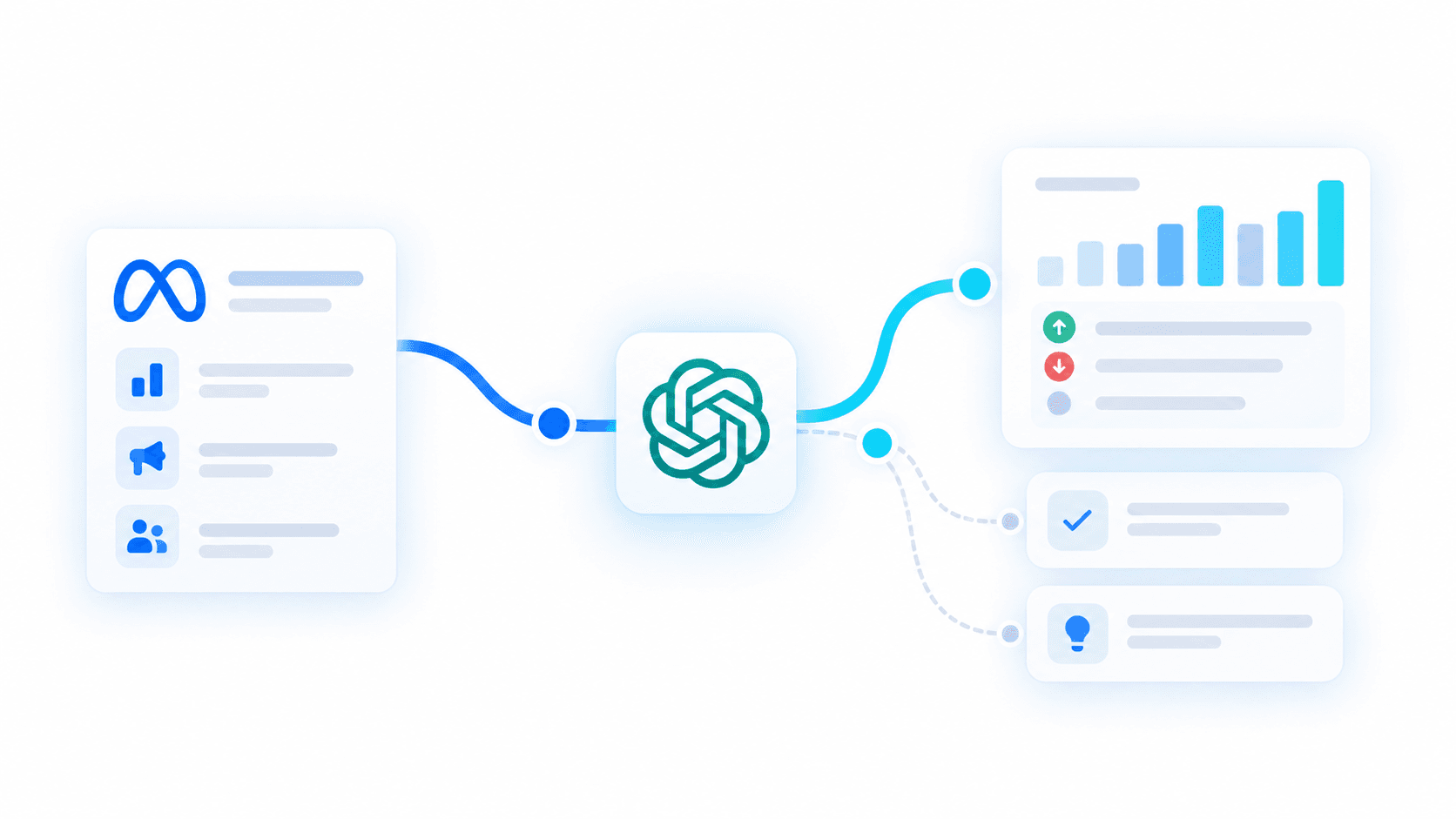
Meta now offers an AI business assistant for advertisers, so connecting an advertising account to ChatGPT deserves a clear business case. In a client reporting experiment, I used an authorised Meta Ads MCP connection to retrieve recent performance information and present it as a structured summary inside ChatGPT. The workflow worked for reporting. Whether it should replace a native Meta workflow depends on the data sources, analytical requirements and privacy controls involved.
What I tested with a client advertising account
The task was specific: summarise advertising performance over the previous 10 days. Rather than manually arranging columns and exporting a report from Ads Manager, I asked ChatGPT for a recent performance overview.
A representative request was:
Summarise my Meta advertising performance over the last 10 days. Present the key metrics in a table and identify results worth investigating.
The connected tool returned advertising information that ChatGPT could organise into a readable report. This demonstrated that a conversational interface could retrieve and summarise the connected account's performance information.
It did not establish that the report was faster than Meta's native assistant, that the analysis was more accurate, or that the integration could safely edit campaigns. I did not test automatic campaign changes or an end-to-end quality assurance workflow.
The useful finding was narrower: a marketer could request a report in ordinary language and work with the returned information without first building that specific table in Ads Manager.
How the MCP connection works
Model Context Protocol (MCP) is an open standard for connecting AI applications with external tools. A connected tool exposes operations that the assistant can call, subject to the user's permissions.
For advertising reporting, the sequence is straightforward:
- A marketer asks a question about campaign performance.
- The assistant selects an available reporting operation.
- The integration retrieves permitted information from the advertising account.
- The assistant formats and interprets the response.
- The marketer checks the figures and investigates the findings.
The integration defines what the assistant can actually do. MCP does not automatically grant access to audiences, placements, creative assets, account settings or campaign editing. Those capabilities require appropriate operations and permissions.
Meta AI versus ChatGPT MCP: What is the practical difference?
Meta has been expanding its own advertiser-facing AI assistant. In its January 2026 product update, Meta described tests of a business assistant for account support, optimisation and personalised recommendations. Its October 2026 Advertising Week announcement described deeper business context and testing of additional planning, creation, optimisation and task capabilities. Availability and eligibility can vary by account.
For questions confined to a single Meta account, the native assistant may be the simpler choice. The case for an external assistant grows when the analysis requires information or workflows outside Meta.
Decision point | Meta's native AI assistant | ChatGPT with Meta Ads MCP |
|---|---|---|
Questions about Meta campaigns | Designed for Meta account support and guidance | Depends on exposed reporting operations |
Natural-language interaction | Available for eligible advertisers and features | Available through the conversation |
Meta-specific recommendations | Part of the native product direction | Generated from retrieved information and must be checked |
Cross-platform reporting | Not a core verified capability of the native assistant | Possible when additional authorised data tools are connected |
Custom reporting logic | Depends on Meta's product controls | Can be defined in a prompt or repeatable workflow |
CRM and commerce reconciliation | Requires additional systems | Possible with suitable integrations and permissions |
Campaign changes | Subject to native feature availability and permissions | Only when the integration exposes write operations |
Governance | Review Meta's data practices | Review OpenAI, Meta and the integration provider |
ConversionNest's view: Start with Meta's own tools for straightforward Meta-only questions. An MCP workflow becomes more interesting when you need the same reporting definitions across multiple channels, or when campaign results must be reconciled with actual business outcomes.
The reporting advantage is not another ROAS table
Platform-reported revenue can overlap across advertising systems. If Meta and Google both attribute a sale to their campaigns, summing their reported revenue can exaggerate business performance.
Consider a hypothetical ecommerce retailer running Meta and Google campaigns. The business wants to decide where to allocate next month's budget. A useful analysis would need advertising spend and platform-attributed conversions, but also ecommerce orders, refunds and product margin.
With appropriate tools, a conversational workflow could collect these sources and make the differences visible. It would still need explicit attribution definitions, consistent reporting windows and human judgment.
The commercial question is whether the additional workflow changes a decision. A report that simply reproduces Ads Manager's table may not justify the extra integration.
For a related approach to choosing useful measures, see our guide to KPIs that change a decision.
A possible next use case: Read-only campaign quality control
I am interested in extending this idea from reporting to pre-launch checks. That is a proposed workflow, not a feature I have validated end to end.
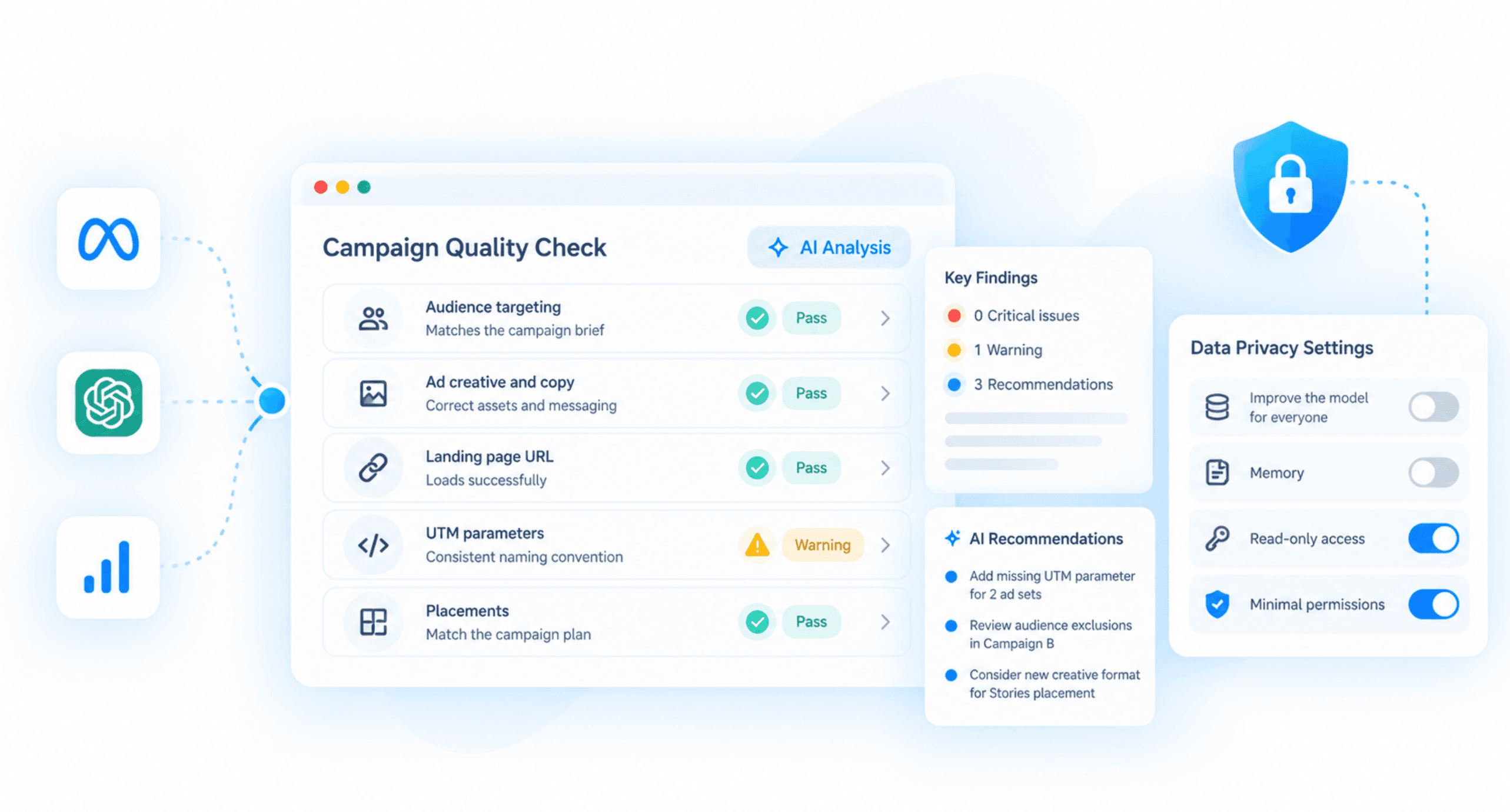
An assistant could compare campaign settings with an approved brief, then return an exception report. The checks might include targeting, ad copy, creative dimensions, destination URLs, UTM conventions and placements.
Check | Evidence needed | Possible finding |
|---|---|---|
Audience | Ad set targeting and approved brief | Unexpected inclusion or exclusion |
Ad copy | Actual ad text and approved copy | Mismatch requiring review |
Creative | Asset dimensions and placement requirements | Unsuitable format |
Destination URL | Ad destination and live page response | Broken page |
UTM tracking | Destination query parameters and naming rules | Missing or inconsistent tags |
Placements | Configured placements and campaign plan | Unexpected delivery setting |
Some checks require Meta configuration data; others require a separate website-checking tool. A report should identify which checks were performed, which could not be performed and which findings are merely suggestions.
For client accounts, I would begin with read-only access. The assistant could inspect and report, while a marketer would approve and implement any changes. Avoid giving a reporting tool permission to publish or edit campaigns unless the workflow genuinely requires it.
Protecting client data: The settings and limits to understand
An advertising account can contain commercially sensitive information. Before connecting it to any AI tool, review what the tool can access, what the provider retains and whether the client has authorised the workflow.
Turn off model improvement on a personal ChatGPT account
For personal ChatGPT plans, go to Settings > Data Controls > Improve the model for everyone > Off. OpenAI's Data Controls documentation explains that new conversations will not be used for model training when this setting is off.
This setting does not mean that no information is processed or retained. It also does not revoke access from a connected application or change a third-party MCP provider's data policy.
OpenAI notes that submitting feedback on a response can have separate implications for training; review the model improvement documentation before using sensitive client material.
Check Memory separately
Memory and model training are separate controls. Review Settings > Personalization > Enable memory if you do not want eligible connected information used for future personalisation.
OpenAI's connected apps documentation explains that information accessed through apps may be used as context, subject to settings and restrictions. Turning off Memory does not delete existing chats or disconnect an app.
Review the MCP provider and permissions
An MCP server may be operated by a platform, your own organisation or an independent provider. The ChatGPT model-training toggle does not control a separate server's logging, storage or processing.
Before authorising a connection, check:
- Which advertising accounts and fields the tool can read.
- Whether it has write access or can publish changes.
- Whether it logs retrieved data and for how long.
- How to revoke credentials and remove access.
- Whether personal identifiers are necessary for the task.
- Whether the client's contractual and privacy requirements allow the processing.
Avoid transferring customer emails, phone numbers or other personal identifiers when campaign-level aggregates are sufficient.
Would a business workspace be more appropriate?
OpenAI states that inputs and outputs from ChatGPT Business and Enterprise are not used for model training by default. See OpenAI's business data documentation.
That may simplify one part of the governance assessment, but the integration provider's terms, data access and retention still need separate review. No workspace setting makes an external connection automatically suitable for confidential client data.
How I would validate the workflow before relying on it
A working demo is not the same as a production reporting process.
Reconcile the data: Compare results against Ads Manager using identical dates, attribution windows, time zones and metric definitions. Record any mismatches.
Test the interpretation: Ask the assistant to separate observations from hypotheses. A rise in CPA does not establish creative fatigue or audience saturation.
Check failure behaviour: Determine what happens when permissions expire, an account cannot be accessed or a metric is unavailable. Missing information should be reported rather than estimated.
Keep an audit trail: Record the requested reporting period, data source and definitions. Sensitive raw client data should not be copied into unrelated tools or documents.
Measure the operational benefit: Compare the end-to-end time and review effort against the native workflow. A more complex system needs to deliver a real benefit.
Which approach would I choose?
For a marketer asking what changed in one Meta campaign, Meta's native assistant is a sensible first stop.
For a team that wants to connect Meta spend with Google Ads, CRM stages, ecommerce revenue and margin, an MCP-enabled workflow deserves evaluation. It offers flexibility, but it also adds integration and governance work.
My client experiment confirmed one practical capability: retrieving recent Meta performance information and presenting it as a conversational summary. The next useful test is a controlled, read-only campaign audit, followed by cross-platform reporting against actual business results.
The decision should rest on reporting accuracy, useful decisions and operational effort, rather than the novelty of connecting another AI tool.
Frequently asked questions
Can ChatGPT retrieve Meta Ads data through MCP?
Yes, when an authorised integration exposes the necessary reporting operations. Available data depends on the specific tools and account permissions.
Is ChatGPT better than Meta AI for advertising analysis?
For Meta-only questions, the native assistant may be simpler. ChatGPT becomes more useful when a workflow needs external tools, custom analysis or multiple data sources.
Does turning off model training make client data completely private?
No. The setting stops new eligible conversations being used for model training, but data processing, retention, Memory and third-party integration terms require separate review.
Can MCP automatically fix campaign mistakes?
Only if the integration exposes the necessary actions and permissions. A read-only audit with human approval is a safer starting point for client work.

Sima Damar Beygu
Founder of ConversionNest. 10+ years in growth marketing, managing 300K euro monthly media budgets and scaling acquisition across 15+ markets. Google and Meta certified.
Sima on LinkedIn
Google Playground for Marketing: Can AI-Generated Games Become Interactive Ads?
Could Google Playground help brands create interactive advertising experiences? Explore practical marketing use cases, platform restrictions, measurement strategies, and commercial risks.
Digital Marketing for Small Business, Without the Overwhelm
You do not need to be on every channel. You need the two or three that reach your buyer, done properly and measured honestly.

Meta product browsing may change where ad clicks land
Meta is switching product browsing on for existing ads unless advertisers opt out. Audit catalogue accuracy, post-click measurement and commercial impact before deciding.