Meta product browsing may change where ad clicks land
From October 28, Meta may show an in-app product experience before your website, changing landing page control and measurement.


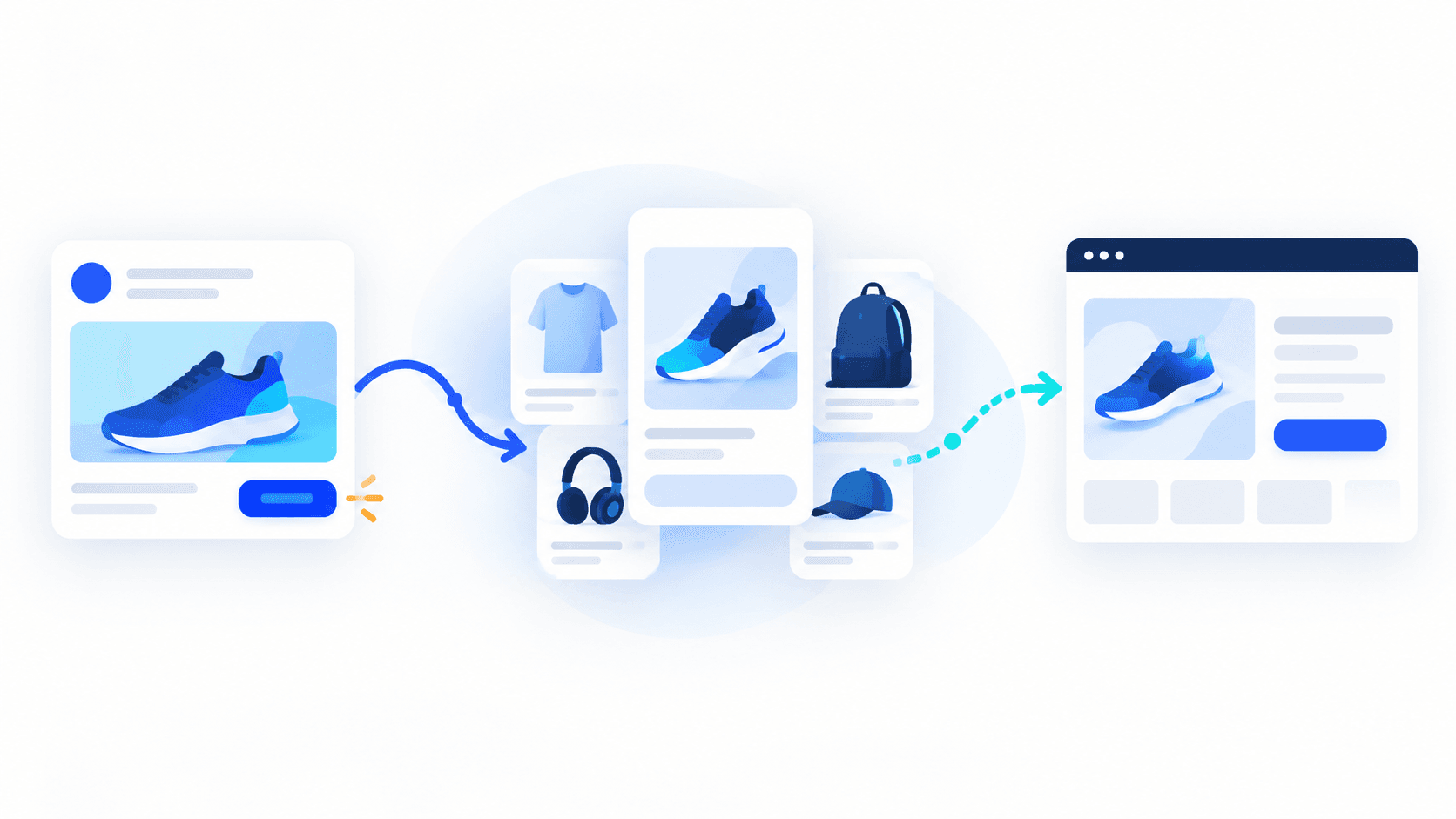
Meta told advertisers in mid-October 2026 that product browsing will be added to existing Facebook and Instagram ads from October 28 unless they opt out. When someone taps an ad, Meta may show an in-app page with product information and personalised suggestions before the advertiser's website.
The change does not mean every click will stop reaching your landing page. It does mean that the first post-click experience may no longer be the page you designed. For ecommerce teams, the commercial question is whether an extra shopping layer improves purchases or weakens message continuity, measurement and control.
What is Meta product browsing?
Product browsing is an Advantage+ creative enhancement that can insert a personalised shopping experience inside Facebook or Instagram after someone taps an ad. The experience may show product details, offers and suggestions before the person continues to the advertiser's website.
Meta's advertiser notice, as documented by PPC Land, says the setting will switch on for existing ads from October 28, 2026. Advertisers can use the notice's opt-out route before that date or change the setting at ad level under Advantage+ Creative and Destination settings.
Ads Uploader's October change log independently records the same October 14 notice and describes the control under personalised destinations. Both sources note that Meta had not published a public Help Center page, changelog entry or Newsroom announcement for this specific default change when checked.
That lack of public documentation matters. The notice does not clearly define which objectives, placements, formats or markets are affected. It also does not say whether ads created after October 28 will use the same default. Advertisers should confirm the setting inside each relevant account rather than assume universal eligibility.
Status checked on October 20, 2026: The switch-on date and controls come from Meta's advertiser notice as reproduced by industry sources. Meta had not published a public product page explaining the rollout, so account-level availability and scope still require verification.
Your landing page may no longer be the first stop
A direct post-click journey is simple: the person taps the ad and reaches the advertiser's chosen URL. With product browsing, Meta may place an in-app product experience between those two actions.
That additional layer can help a shopper compare products without waiting for a website to load. It can also change the story the advertiser intended to tell. A carefully matched landing page may contain an offer, buying guide, proof points or bundle logic that is absent from a catalogue-led experience.
The risk is highest when the ad and landing page work as one sequence. Consider a creator ad that introduces a specific use case and links to a page built around that problem. If product browsing surfaces different items first, the visitor may see a broader assortment before receiving the context that made the original offer persuasive.
ConversionNest's view: product browsing is a destination test, not a harmless creative enhancement. Treat it with the same discipline you would apply when changing a landing page.
What does Meta's 3% conversion claim prove?
Meta's notice says businesses in its test saw 3% more conversions on average. PPC Land reports that the experiment ran globally from August 6 to August 21, 2026, involved about 117,700 advertisers and covered at least ecommerce, consumer packaged goods and retail.
The result is Meta's own platform claim. The notice does not define the conversion events, attribution window, test allocation, average calculation, cost per conversion, revenue or distribution of outcomes. A statistically significant average does not show that every advertiser benefited.
The test also does not establish that product browsing creates incremental sales. More Meta-attributed conversions could reflect a better shopping experience, a different attribution path or a mix of both. Revenue, margin and verified orders remain the stronger decision measures.
Meta has published a comparable warning for a different in-app advertising format. Its Audience Network format guidance says extra interaction opportunities can increase click-through rate while conversion rate per click may decline. That document does not describe Facebook or Instagram product browsing, but it supports a broader measurement principle: changing the interaction surface can change click metrics without proving a proportional business gain.
Where the change can distort your measurement
Product browsing can change the relationship between Meta clicks and website sessions. A person may interact with the in-app experience but never load the advertiser's site. That can widen the gap between link clicks and landing page views, although the size of any change will depend on delivery and user behaviour.
Website analytics may also observe a more selected audience. Visitors who continue to the site have already passed through another shopping layer, so their conversion rate may differ from the previous traffic mix. Comparing website conversion rates before and after October 28 without noting the destination change could produce the wrong conclusion.
Creative analysis becomes harder too. If an ad's reported results partly come from product suggestions generated around it, performance cannot be attributed cleanly to the original creative alone. PPC Land reports this concern from media buyers, but those individual account experiences have not been independently verified by Meta.
Do not combine unlike signals in one conclusion:
- Meta link clicks: These record interactions defined by Meta, not guaranteed website arrivals.
- Landing page views: These indicate that a destination page loaded, but may fall if users remain in the in-app experience.
- Website sessions: These depend on analytics consent, loading and channel classification.
- Orders and net revenue: These show commercial outcomes, but still need consistent attribution and refund treatment.
- Meta-attributed purchases: These support platform optimisation and reporting, but do not prove incrementality.
Our guide to choosing decision-useful KPIs explains why each metric should be tied to a specific decision.
Who should test it and who should opt out first?
Product browsing may deserve a controlled test when the catalogue is accurate, the product range benefits from exploration and the website destination is already a straightforward product page. It may also help when mobile site speed is weak, although improving the site remains the better long-term fix.
Opting out first is more defensible when the landing page carries essential context or compliance information, the ad promotes a specific bundle, or the catalogue contains products that should never appear together. The same applies when pricing, availability, imagery or product sets are unreliable.
Campaigns built around lead generation, editorial content or a service proposition require extra caution. The public notice does not specify their eligibility, and a catalogue browsing layer may not match the user's intent even if the setting appears.
The decision should be made per use case, not for the whole account by instinct.
Audit product browsing before October 28
Review the change while you still have a clean baseline.
1. Identify affected accounts and live ads
Open the notice for each business portfolio and confirm which ad account it refers to. Then inspect live ads under Advantage+ Creative and Destination settings. Do not assume one opt-out covers every client or account.
2. Check catalogue and message consistency
Review product titles, images, prices, stock status, product sets and destination URLs. Confirm that personalised suggestions cannot create an obvious mismatch with the ad's claim, licensed range or promotion.
3. Save a pre-change baseline
Record spend, impressions, link clicks, landing page views, website sessions, purchases, net revenue and contribution margin using consistent attribution settings. Note the date and any seasonal promotion that could affect comparison.
4. Choose a testing unit
Where account controls allow it, compare product browsing with the direct destination while holding audience, offer and creative as stable as possible. Avoid changing budgets, catalogue structure and landing pages at the same time.
5. Review the full journey
After launch, compare Meta reporting with analytics and order data. Investigate changes in click-to-session rate, product mix, average order value, refund rate and contribution margin before declaring a winner.
What advertisers should do now
First, locate the notice and verify the affected account. If you depend on a purpose-built landing page or cannot validate catalogue accuracy, opt out before October 28 and plan a controlled test later.
If you keep product browsing enabled, document the setting at ad level and monitor the complete path from interaction to net revenue. Separate Meta's official notice, platform-reported outcomes and your own business data in the analysis.
The feature may improve discovery for some retailers. It may also insert friction or dilute the message for others. The correct decision will come from a measured destination test, not from a platform average with important details missing.

Sima Damar Beygu
Founder of ConversionNest. 10+ years in growth marketing, managing 300K euro monthly media budgets and scaling acquisition across 15+ markets. Google and Meta certified.
Sima on LinkedIn
Why ad performance suddenly drops: a structured diagnosis
A sudden decline needs a timeline and a verified failure point. Use this diagnostic sequence before changing budgets, targeting or creative.

Google Ads Lead Form Qualifying Responses: Audit the Bidding Signal
Qualifying responses can create a cleaner Google Ads lead signal. Learn how to audit the form logic, CRM delivery and downstream value before bidding uses it.

Meta's new brand ads: what growth teams should test
Meta introduced Ads Super Burst, First Impression Ads, expanded Reels Trending Ads and Aggregated View Time. Assess their availability and commercial value.