Do reviews on your website build trust, or just sit there?
Reviews only earn trust when visitors see them at the moment of doubt and have reason to believe they are real.

- Reviews persuade when they are specific, recent, close to the button and clearly from real customers.
- Research on online reviews found most of the effect comes from the first few reviews, and that near-perfect ratings can be less convincing than very good ones.
- Place reviews on service pages next to the main action, not only on a separate testimonials page.
- Fake, paid-for-sentiment and undisclosed staff reviews are banned in Ireland, across the EU and in the US.
Reviews on your website build trust when they are specific, recent, close to the point where visitors decide, and clearly from real customers. A testimonials page full of anonymous "Great service!" quotes does little, because visitors rarely go looking for it and have no reason to believe it.
Most published research on reviews comes from e-commerce product pages, so treat it as direction for a service business, not a forecast. The rules are clearer: fake reviews are now illegal in Ireland, across the EU and in the US. For a service business, the commercial question is whether the visitors who almost get in touch see enough proof, at the right moment, to take the step.
What research says about reviews
The most cited study comes from Northwestern University. The Medill Spiegel Research Center's report, first published in 2017, found that a product with five reviews had a purchase likelihood 270% greater than one with none, and that the benefit of further reviews dropped quickly after the first five.
Three other findings from the same report matter for service businesses:
- Higher value, bigger effect: displaying reviews raised conversion more for higher-priced products (380%) than lower-priced ones (190%). Many services are high-value decisions.
- Perfect is not best: purchase likelihood typically peaked between 4.0 and 4.7 stars and fell as ratings approached 5.0.
- Verified helps: verified buyer badges improved the odds of purchase by 15%.
ConversionNest's view: you do not need hundreds of reviews. You need a handful of believable, specific ones in the right places, and a steady flow of new ones.
Put reviews where people hesitate
Visitors look for reassurance at the moment of doubt: just before they call, book or ask for a quote. That is where reviews belong.
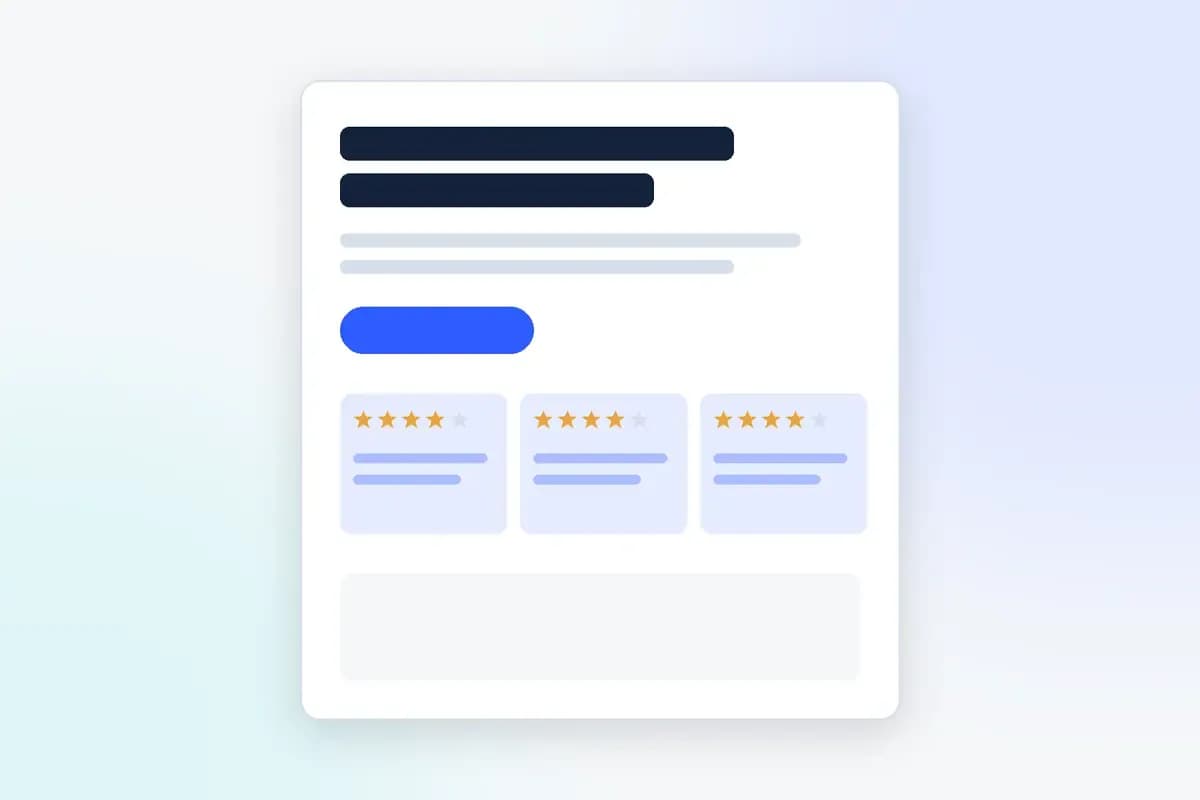
- Next to the main button: two or three short reviews directly above or below "Call now" or "Get a quote".
- On each service page: a review about boiler repair belongs on the boiler repair page, not mixed with reviews about bathroom fitting.
- Near the price: if you show prices or a starting price, a review that mentions value sits well beside it.
- On the contact page: the last page before an enquiry is a good place for one more reason to go ahead.
A separate testimonials page can stay, but treat it as an archive, not your main proof.
Make each review believable
A review persuades when it sounds like a real person describing a real job. Generic praise reads like marketing.
Weak review | Believable review |
|---|---|
"Great service, highly recommend!" | "Boiler stopped on a Sunday. They came out the same evening and fixed it in an hour." |
No name | First name and town, with permission |
No date | Month and year |
No source | Link to where it was posted, such as your Google Business Profile |
These examples are hypothetical. Two habits help: ask happy customers a specific question, such as "What problem did we solve for you?", and never edit the wording beyond fixing obvious typos with their agreement.
Stay on the right side of the rules
This section is general information, not legal advice. Check your own situation with a professional.
- Ireland: the CCPC confirmed that the Consumer Rights Act 2022, in force from 28 November 2022, bans businesses from posting fake reviews of their own products or paying others to post them.
- EU checks: in a 2022 sweep of 223 major websites across 26 member states, authorities had doubts about the reliability of reviews on almost two-thirds, and just over half did not explain how fake reviews were prevented.
- United States: the FTC's final rule on reviews, announced in August 2024, prohibits fake reviews, paying for reviews of a particular sentiment, undisclosed reviews from company insiders, and using threats or intimidation to remove negative reviews.
In practice: never write reviews yourself or with AI, never offer a discount only for positive reviews, label any review from staff or family, and if you say reviews are verified, be able to show how.
A worked example: an electrician's website
Consider a hypothetical electrician. This is an illustration, not a client result.
Before. A "Testimonials" page in the menu holds twelve undated quotes, such as "Brilliant job!" and "Very professional", signed with initials only. Service pages have no reviews.
After.
- Each service page: three reviews about that service, with first name, town and month, placed under the "Book a visit" button.
- Source: a link to the full set of reviews on the electrician's Google Business Profile.
- Recency: after each job, the electrician sends one message asking what problem was solved, and adds the best new review to the matching page every month.
The electrician has the same customers and the same reviews. Visitors now see them at the moment they decide.
Audit your reviews in an hour
A review check for a service website
- List where reviews appearNote every page that shows a review, and every important page that does not. Allow 10 minutes.
- Check the decision pointsMake sure each service page and the contact page show at least two relevant reviews near the main button. Allow 20 minutes.
- Test believabilityFor each review, check it has a name, a date and a specific detail. Replace generic ones with better real reviews. Allow 20 minutes.
- Check the rulesRemove anything you cannot show came from a real customer, and label staff or family reviews. Allow 10 minutes.
If your page still struggles after this, check the rest of the first screen with our five-second homepage test, and the last step with our guide to contact forms that get ignored.
Before you ask for more reviews, move the good ones you already have next to the button visitors hesitate over.

Sima Damar Beygu
Founder of ConversionNest. 10+ years in growth marketing, managing 300K euro monthly media budgets and scaling acquisition across 15+ markets. MSc in Digital Marketing from University College Dublin. Google and Meta certified.
Sima on LinkedIn
Collection pages that don't sell: fixing categories, filters and sorting
If shoppers reach your collection pages but rarely click a product, the problem is often the first rows, the filters or the sort order. Here is how to find and fix it.
Why visitors ignore your contact form, and how to fix it
A contact form that nobody fills in is usually hard to find, asks too much or gives no reason to trust it. Here is how to diagnose yours and fix it in an afternoon.
Is your online store too slow? How page speed costs sales
A slow product page on a phone can quietly cost an online store sales. Here is how to read your speed data, which pages to check first, and what usually slows small stores down.